
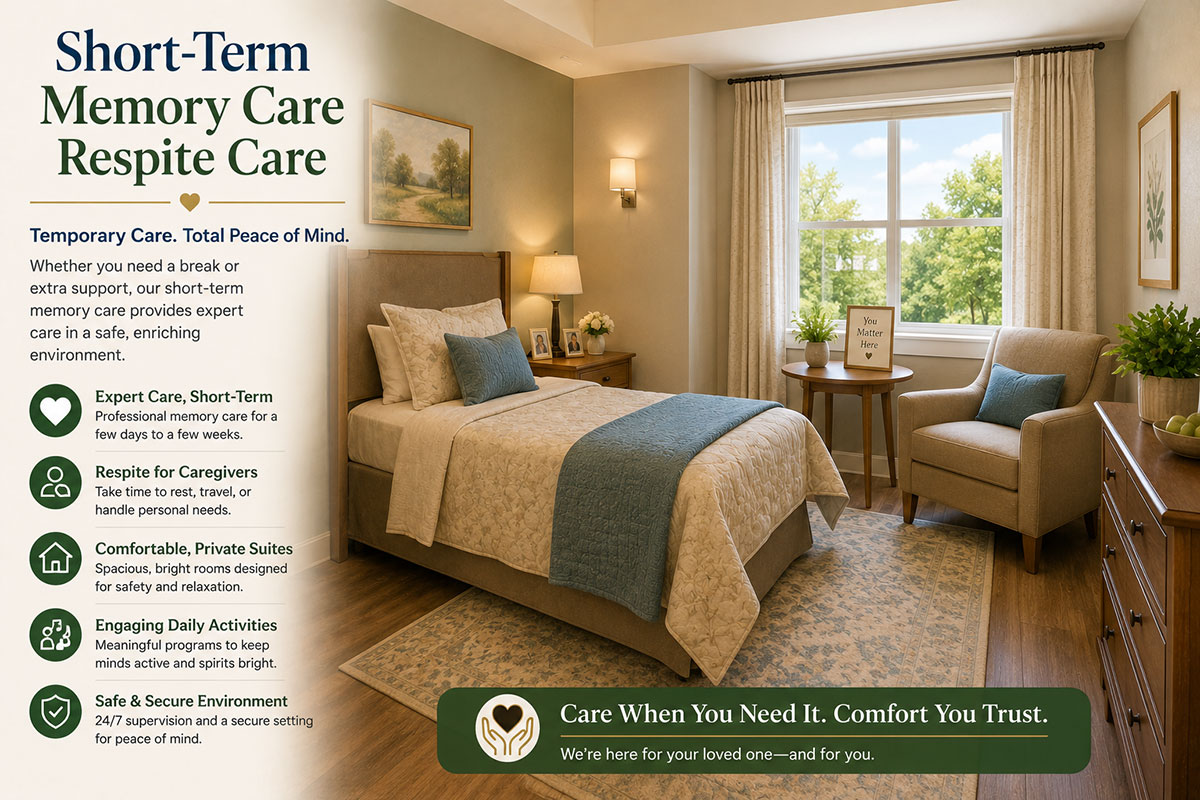
Family caregivers of someone with dementia often reach a point of exhaustion long before they consider that help exists — not because they don’t want a break, but because taking one can feel impossible, or even guilt-inducing, when the alternative is leaving a loved one’s care to someone else, even briefly. Short-term and respite memory care exists precisely for this moment, offering a professionally supported break without requiring a permanent decision.
This guide explains how respite memory care works in Las Vegas, who it’s for, and why it’s often the first step toward long-term peace of mind, not just a temporary fix.
What Respite Memory Care Actually Is
Respite care is a short-term stay in a memory care community — ranging from a few days to a few weeks depending on the facility and the family’s needs — that gives family caregivers a genuine break while their loved one receives the same specialised dementia care and structured environment as a long-term resident. It’s not a lesser version of memory care; it’s the same trained staff, the same programming, the same safety-focused design, simply for a defined period.
Respite stays are commonly used around a caregiver’s own medical procedure or recovery, a family event or trip that would otherwise require leaving a loved one unsupported, or simply a planned period of rest to prevent caregiver burnout before it becomes a crisis.
The Caregiver Burnout Risk Respite Care Addresses
Caregiver burnout among people caring for a loved one with dementia is well documented, and it doesn’t just affect the caregiver’s own health — sustained exhaustion tends to reduce the quality of care they’re able to provide too, creating a cycle that serves no one well. Respite care interrupts that cycle before it compounds, giving caregivers the rest needed to sustain caregiving over the long term rather than reaching a breaking point.
For families feeling too depleted to even consider the idea of a break, it’s worth reframing respite care not as giving something up, but as an investment in being able to keep showing up for a loved one over months and years, rather than running on empty until something has to give.
Why Respite Often Becomes the First Step Toward Long-Term Care
A meaningful number of families who try a respite stay find it becomes the natural bridge into longer-term memory care, for reasons that make sense once you see it happen — the loved one gets a genuine, hands-on experience of the community, its staff, and its rhythm, rather than a decision being made purely from an outside tour. Families, too, get to see firsthand how their loved one is cared for, which builds a level of trust and confidence that’s hard to reach through a tour alone.
There’s no obligation attached to a respite stay leading to a longer placement, but if and when a family does reach the point of needing full-time memory care, having already experienced the community removes a huge amount of the uncertainty and second-guessing that often accompanies that harder, more permanent decision.