
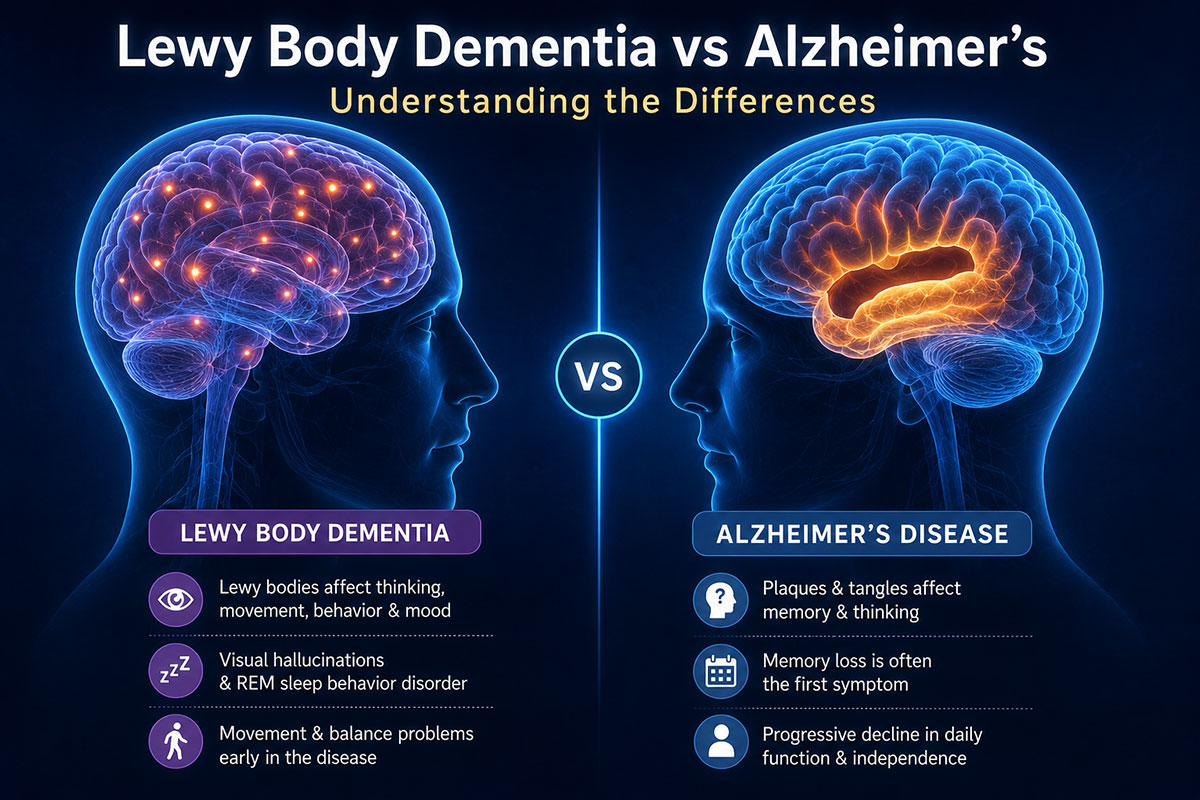
When a diagnosis of dementia arrives, most families brace themselves for Alzheimer’s, simply because it’s the form most widely discussed. So when the diagnosis comes back as Lewy body dementia instead, families are often left searching for answers with far less information available to them, and far fewer facilities that clearly explain how they’d care for it.
Lewy body dementia is actually the second most common type of progressive dementia after Alzheimer’s, yet it remains widely misunderstood — even, at times, misdiagnosed. This guide explains what makes it different from Alzheimer’s, why that difference matters for day-to-day care, and what to look for in a memory care community equipped to support it.
What Is Lewy Body Dementia?
Lewy body dementia is caused by abnormal deposits of a protein called alpha-synuclein, known as Lewy bodies, that build up in areas of the brain affecting thinking, memory, movement, and behaviour. It’s considered an umbrella term covering two related conditions — dementia with Lewy bodies and Parkinson’s disease dementia — which share overlapping symptoms but differ in the order those symptoms typically appear.
Because Lewy body dementia affects some of the same brain regions as Alzheimer’s, memory problems are present in both, which is part of why the two are so often confused with one another in the early stages.
Key Differences Families Should Understand
The most distinctive feature of Lewy body dementia is fluctuating cognition — a person may seem clear, engaged, and articulate one hour, and confused or unresponsive the next, sometimes within the same day. Alzheimer’s, by contrast, tends to progress more steadily and predictably over time, without those dramatic swings.
Visual hallucinations are also far more common and appear far earlier in Lewy body dementia than in Alzheimer’s — a person may describe seeing people, animals, or patterns that aren’t there, often described in vivid, specific detail rather than vague confusion. Movement symptoms resembling Parkinson’s disease — a shuffling gait, tremor, or stiffness — frequently appear as well, which is rare in Alzheimer’s until much later stages.
One difference with serious care implications is sensitivity to certain antipsychotic medications: people with Lewy body dementia can have severe, sometimes dangerous reactions to medications that are sometimes used to manage agitation or hallucinations in other forms of dementia. This is a critical piece of information any care team needs to know from the outset.
Why This Distinction Matters for Choosing Memory Care
A memory care community that primarily understands Alzheimer’s care may not be prepared for the specific presentation of Lewy body dementia — the fluctuating alertness that can look like a medical emergency to an untrained eye, the hallucinations that require a calm, validating response rather than argument or correction, and the medication sensitivities that make careful physician coordination essential.
Families should feel comfortable asking a prospective memory care community directly: has your staff been trained specifically on Lewy body dementia, do you coordinate closely with residents’ physicians on medication choices, and how do your caregivers typically respond when a resident describes a hallucination? The answers to these questions reveal far more about a community’s actual readiness than a general tour of the building.
What Specialised Support Looks Like Day to Day
In practice, good Lewy body dementia support means staff who recognise fluctuating cognition as a symptom of the condition rather than something alarming or inconsistent, who are trained to respond to hallucinations with reassurance rather than confrontation, and who closely track and communicate any movement changes that could indicate a fall risk, since Parkinsonian symptoms increase that risk meaningfully.
It also means close, ongoing communication between the care team and the resident’s physician, particularly around any new medication, since the sensitivity risk with certain drug classes makes that coordination non-negotiable rather than a nice-to-have.