
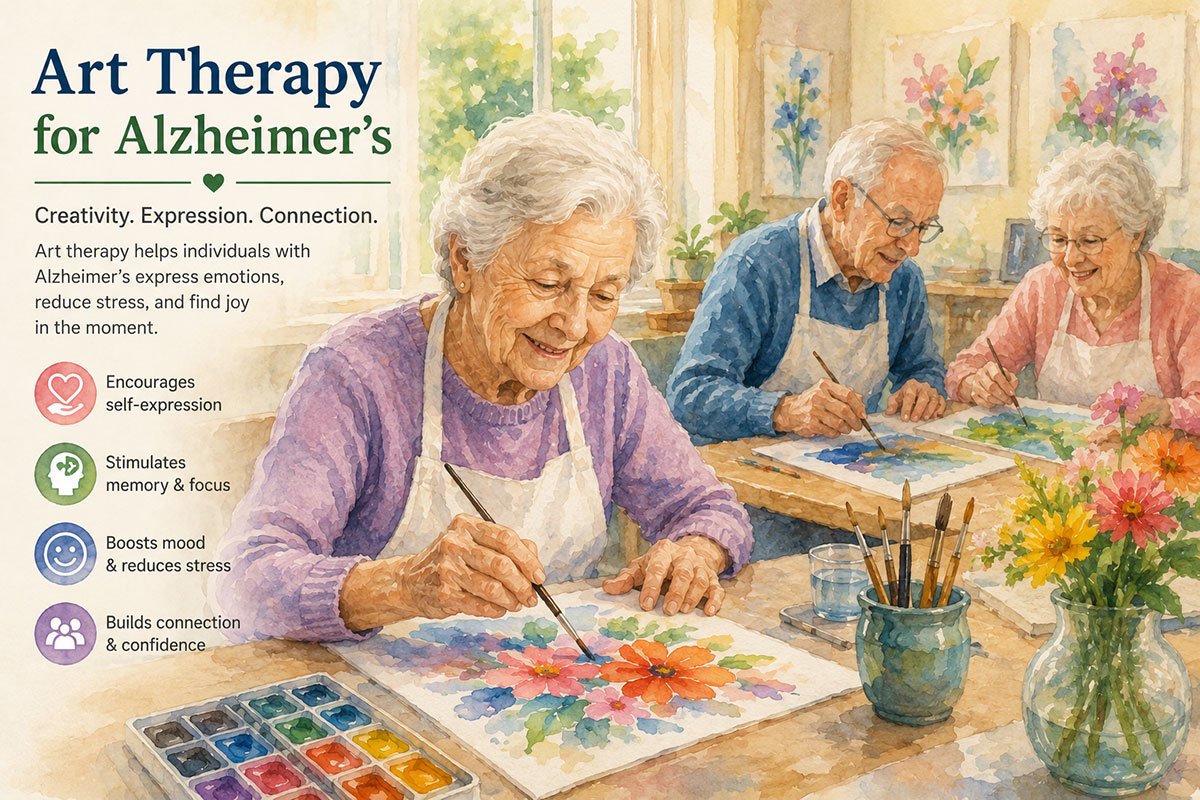
It’s a striking pattern that shows up again and again in dementia care: a resident who struggles to find words in conversation can still pick up a paintbrush and create something expressive, focused, and entirely their own. Art doesn’t rely on the same cognitive pathways as verbal language, which is exactly why it has become one of the most valued tools in dementia care — not as a way to pass the time, but as genuine, evidence-supported engagement.
This guide looks at why art therapy works for people living with Alzheimer’s and other dementias, and what a thoughtfully run creative activities programme actually looks like.
Why Art Reaches People When Words Sometimes Don’t
Dementia progressively affects language and verbal memory, but the parts of the brain involved in visual and creative expression are often relatively preserved for longer. That’s why a resident who can no longer easily hold a conversation may still engage fully in painting, drawing, or working with colour and texture — the activity taps into a different, still-accessible part of cognitive and emotional function.
Beyond the neurological explanation, art offers something equally important: a sense of accomplishment and self-expression at a stage of life when many other forms of independence have been lost. Completing a piece of art, however simple, gives a resident a tangible result they created themselves — a meaningful source of pride and identity.
The Evidence Behind Art Therapy in Dementia Care
A growing body of research on creative arts interventions in dementia care has found associations with reduced agitation, improved mood, and increased social engagement among participants, particularly when sessions are structured around sensory and creative activity rather than requiring precise recall or instruction-following. Art therapy is also frequently noted for its ability to provide a calming, focused activity for residents who experience anxiety or restlessness, offering an alternative outlet that doesn’t depend on verbal processing.
It’s worth noting that art therapy is a complement to, not a replacement for, comprehensive dementia care and any prescribed treatment — its value lies in quality of life, emotional wellbeing, and engagement rather than as a treatment for the underlying condition.
What Art Therapy Looks Like in a Memory Care Setting
Effective programmes are adapted to each resident’s current ability level rather than expecting a uniform outcome — some residents work with paint and brushes, others with simpler tactile materials like clay or collage, and instructions are kept simple, open-ended, and free of pressure to ‘get it right’. The goal is participation and expression, not artistic skill.
Group art sessions also serve a social function beyond the creative activity itself, giving residents a shared, low-pressure setting to be around others, which supports the broader social engagement that’s an important part of quality of life in memory care.