
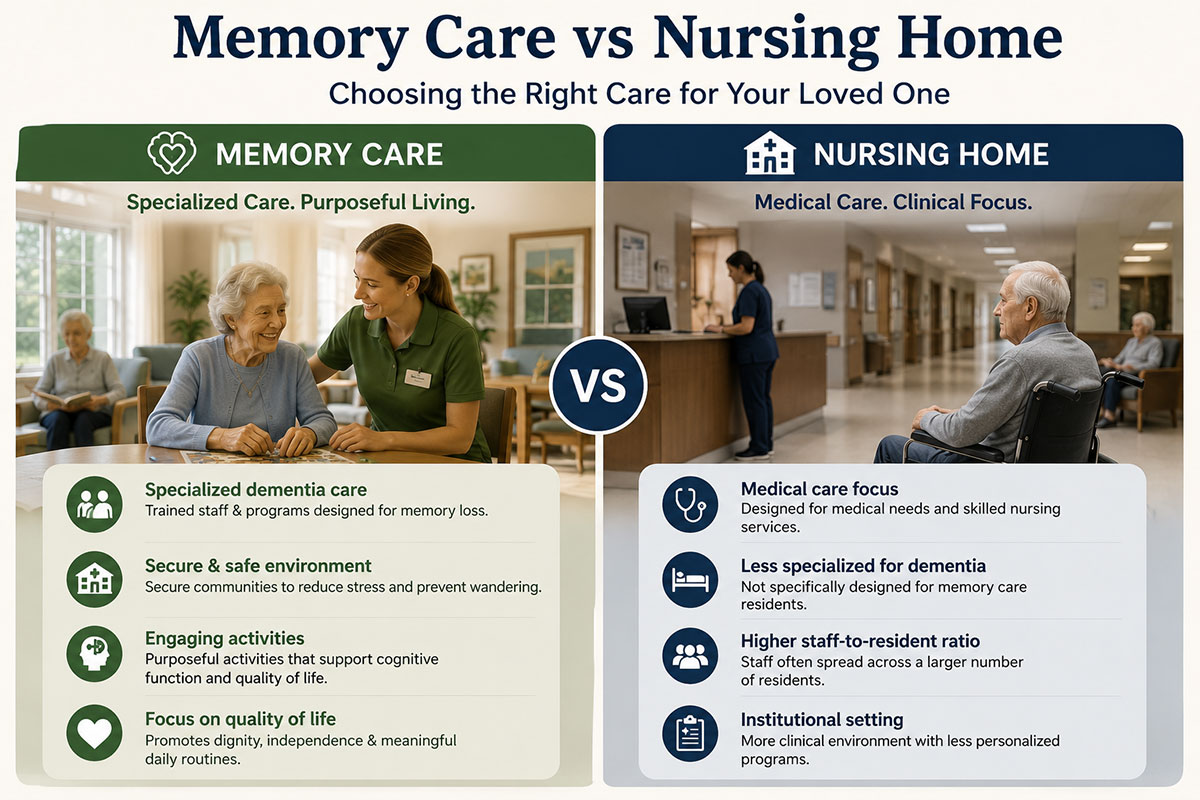
When a loved one is diagnosed with dementia, most families’ first instinct is to think about a ‘nursing home’ — it’s the term that’s been part of the cultural vocabulary for decades. But for someone whose primary need is dementia-specific support rather than acute medical nursing, a nursing home is often not the right fit, and understanding why can make the difference between a placement that feels institutional and one that feels genuinely like home.
This guide compares memory care and nursing homes directly, so families in Las Vegas can make an informed decision based on what their loved one actually needs, rather than the terminology they happen to be most familiar with.
What a Nursing Home Is Designed For
A nursing home, more formally a skilled nursing facility, is built primarily around medical need — residents who require round-the-clock nursing care, recovery after surgery or hospitalisation, or management of complex physical health conditions. Staffing, environment, and daily rhythm are all oriented around medical treatment first.
Nursing homes can and do house residents with dementia, but dementia-specific programming, environmental design, and staff training aren’t always a core focus — a resident with dementia may find themselves in a setting designed for physical recovery rather than the cognitive and emotional support their condition actually calls for.
What Memory Care Is Designed For
Memory care is a specialised form of senior living built specifically around the needs of people living with Alzheimer’s and other forms of dementia. The physical environment is intentionally designed to reduce confusion and wandering risk — clear sightlines, secured entries, consistent layouts — while daily programming focuses on structured, dementia-appropriate activities that support cognitive engagement and reduce anxiety.
Staff in a quality memory care community are trained specifically in dementia care techniques — how to communicate with someone experiencing memory loss, how to de-escalate agitation, how to support someone through the specific behavioural symptoms dementia can bring — rather than general medical nursing skills alone.
Comparing the Two Directly
On environment, memory care tends to feel more residential and home-like, with smaller, more intimate settings, while nursing homes often have a larger, more clinical feel driven by their medical focus. On staff training, memory care staff are trained specifically in dementia behaviours and communication, while nursing home staff training is broader and medically oriented.
On daily structure, memory care builds the entire day around dementia-friendly routine and engagement — a critical factor in reducing agitation and confusion — while a nursing home’s schedule is generally driven by medical and therapy needs rather than cognitive engagement specifically. On cost, pricing structures vary by facility and region, and it’s worth requesting a detailed breakdown from any specific community being considered rather than assuming one setting is categorically cheaper than the other.
How to Decide Which Setting Fits Your Loved One
The clearest signal is the primary need driving the placement. If a loved one’s main challenges are memory loss, confusion, wandering risk, and dementia-related behavioural changes, without a significant acute medical or nursing need, memory care is generally the better-fitted and more supportive environment. If a loved one has dementia alongside a complex medical condition requiring skilled nursing — a recent surgery, a feeding tube, ventilator dependence — a nursing home, or a memory care community with enhanced medical partnerships, may be more appropriate.
It’s also worth touring both types of setting directly, if possible, and paying attention not just to the facilities themselves but to how staff interact with residents who have dementia — that interaction is often the clearest indicator of which environment will actually support quality of life.