
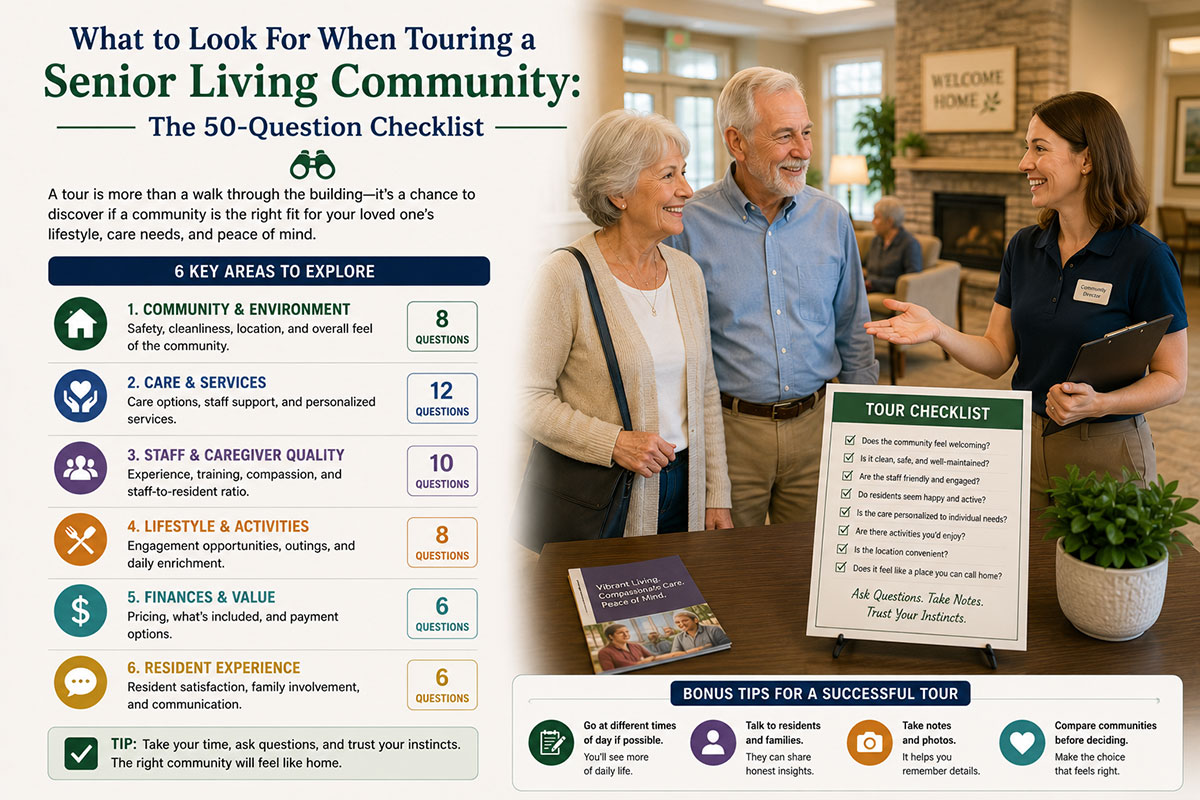
Why Most Families Miss Critical Red Flags on Tours
A senior living tour typically lasts 60 to 90 minutes. A family sees the show apartment, the dining room, the activity spaces. They meet the sales director. The community looks clean and pleasant. They collect a brochure and leave.
Three months after move-in, they discover that the staffing ratio falls short on weekends, that the meals do not match the quality of the chef’s tour demonstration, and that the activities director left two months ago and has not been replaced.
Before the Tour: What to Research Online First
Before you set foot in any community, spend 30 minutes on independent research. Search the community’s name on Medicare’s Nursing Home Compare tool (for skilled nursing facilities). Check your state’s long-term care ombudsman website for complaint history. Read Google and Yelp reviews — focusing on patterns in negative reviews, not individual complaints.
Category 1: Safety and Physical Environment (Questions 1–10)
- Are the hallways, bathrooms, and common areas free of tripping hazards and well-lit at all hours?
- Are handrails present in corridors, bathrooms, and on all staircases?
- What is the call system for residents who need immediate assistance, and how quickly do staff respond?
- Are all exterior doors secured against unauthorised exit (for memory care) and unauthorised entry?
- What is the fire safety and emergency evacuation plan, and when was the last drill conducted?
- Are there outdoor spaces — gardens, walking paths — that are safely accessible to residents?
- How is the community secured overnight? Who has access to resident areas?
- What is the maintenance response time for repair requests?
- How are medications stored and who administers them?
- Has the community received any safety violations or citations in the last three years? Can you see the most recent state inspection report?
Category 2: Staffing and Care Quality (Questions 11–20)
- What is the staff-to-resident ratio during the day, evening, and overnight on weekdays and weekends?
- What is the staff turnover rate? (High turnover is one of the most reliable indicators of management quality.)
- How are staff trained in dementia care, fall prevention, and emergency response? How often is training updated?
- Are the same staff assigned to the same residents consistently, or does staffing rotate frequently?
- Who is responsible for each resident’s care plan, and how often is the care plan reviewed?
- How does the community communicate with families about changes in a resident’s health or wellbeing?
- What happens if a resident’s needs exceed what this level of care can provide? What is the transition process?
- Are there registered nurses on-site (not just on-call) at all hours?
- How are medical emergencies handled? What is the relationship with local hospitals and specialists?
- Ask to speak with a staff member (not selected by management) about what they like and find challenging about working there.
Category 3: Food and Nutrition (Questions 21–30)
- Can you eat a meal during the tour — not a scheduled demonstration, but an actual resident meal?
- How many menu choices are available at each meal, and how are dietary restrictions accommodated?
- What is the process for residents with swallowing difficulties or significant dietary needs?
- Are snacks available between meals, and is the kitchen accessible to residents?
- Who prepares the meals — a professional chef or contract catering? Has the culinary team changed recently?
- How are resident food preferences solicited and incorporated into menus?
- What do residents and family members say about the food? (Ask residents directly during your tour.)
- Are there private dining options for family meals or celebrations?
- What is the dining room atmosphere like at meal time — sociable and pleasant, or institutional?
- Are accommodations made for cultural or religious dietary requirements?
Category 4: Activities, Wellness, and Social Programs (Questions 31–38)
- Can you see the current month’s activities calendar and compare it to last month’s?
- Is there a dedicated, full-time activities director currently employed — not a recent vacancy?
- What fitness programs are available, and are they adapted for residents with mobility limitations?
- Are there regular outings and community trips beyond the campus?
- How does the community address social isolation for residents who are less mobile or more introverted?
- Are intergenerational programs (with schools or youth organisations) part of the activity calendar?
- What spiritual or religious programming is available, and how are different faith traditions accommodated?
- What happens on weekends and evenings — are activities as rich as weekday programming?
Category 5: Financial Transparency and Contracts (Questions 39–44)
- What is included in the base monthly fee, and what services incur additional charges? (Ask for an exhaustive list.)
- What has the rate increase history been over the last five years? (Request this in writing.)
- Under what circumstances can the contract be terminated by the community? What notice is given?
- Under what circumstances can the contract be terminated by the resident or family, and what is the refund policy?
- Is there an entrance fee? Is it fully refundable, partially refundable, or non-refundable?
- Does the community accept Medicaid, Veterans benefits, or long-term care insurance, and what is the process for transitioning to Medicaid if personal funds are depleted?
Category 6: Residents’ Happiness and Community Culture (Questions 45–50)
- Ask to speak privately with two or three current residents — not ones obviously selected for you. What do they enjoy most? What would they change?
- Ask to speak with a family member of a current resident. How responsive has the staff been to their concerns?
- What does the community feel like? Is there genuine warmth and humour between staff and residents, or is the atmosphere institutional and transactional?
- How does management respond to complaints and concerns? Is there a formal feedback process, and can you see evidence that feedback has driven changes?
- What is the community’s philosophy about resident autonomy and dignity? How does this manifest in daily practice?
- Can you visit unannounced before making a final decision? (A community that welcomes unannounced visits is confident in its daily operations.)